
Friday, 15 September 2023

World Ozone Day 2023 Message
Scientists discovered evidence of a serious threat to the ozone layer in the 1980s, which provided the impetus for the development of the Vienna Convention for the Protection of the Ozone Layer and the Montreal Protocol on substances that deplete the Ozone Layer. The Protocol is an international agreement under which countries worldwide are committed to phasing-out Ozone Depleting Substances and Products, and to replacing these damaging chemicals with ozone-friendly substances and products. Some of the ozone depleting chemicals which are targeted by the Montreal Protocol includes: chlorofluorocarbons (CFCs) and hydrochlorofluorocarbons (HCFCs) which are refrigerant, halons which are fire suppressants, and methyl bromide which is a fumigant, as well as products using them or any blends of these chemicals. The refrigerant HCFCs in particular supports cooling services which underpins many important sectors which contribute to sustainable development within the national economy namely the food, fishing, health, tourism and industrial sectors.
The ‘ozone hole’, which forms during the Antarctic winter in September, was created by the destruction of ozone molecules by these ozone depleting substances and can severely affect, not only humans, but also other ecosystems. Research has shown that excessive exposure to ultra-violet radiation is harmful to all life forms, from microscopic plants found in the ocean to farm animals and human beings. Humans are affected through increasing incidences of eye-cataracts, non-melanoma skin cancers, damage to genetic DNA and suppression of the efficiency of the immune system. In this sense there is a true connection between the survival of people and the natural ozone shield.
Trinidad and Tobago signed the Montreal Protocol in 1989 which addressed
the depletion of the ozone layer and set obligations for countries under the
protocol. Since the signing, the National Ozone Unit of the Environmental
Policy and Planning Division (EPPD) developed frameworks and partnerships to
aid Trinidad and Tobago in meeting its obligations.
·
In 1989 all ozone depleting substances such as
refrigerant, and related equipment were placed on the import negative list
and required a license for import.
·
In December 2007 the import of the refrigerant
chlorofluorocarbons (CFCs) and its blends, as well as halon were no longer
allowed.
·
In January 2015 the import of methyl bromide for
use in non-quarantine and reshipment applications was no longer allowed
·
The process of phasing out the refrigerant
hydrochlorofluorocarbons (HCFCs) began in 2013, and in 2015, Trinidad and
Tobago no longer allows the import of all assembled air condition (AC) and
refrigeration units that use HCFCs or its blends.
·
Labelling standards for refrigerants cylinders,
and refrigeration and air conditioning equipment have been developed; all
refrigerant imports are inspected against these standards by the Trinidad and
Tobago Bureau of Standards
·
The Professional Certification Scheme for the
Refrigeration and Air conditioning Industry has been developed. This
certification equips technicians with the knowledge required to deal with rapid
changes within their industry.
·
National Guidelines for the Refrigeration and
Air conditioning Industry have also been developed as well as a National
Cooling Strategy for Trinidad and Tobago.
The Montreal Protocol has had a tremendous
effect on aiding the world in arresting the deterioration of the ozone layer,
and made a landmark decision in October 2016 known as the Kigali Amendment, to
include under its mandate chemicals which were used as ozone depleting
alternatives but which have a negative effect on the climate, such as
hydrofluorocarbons (HFCs). Trinidad and Tobago was the 1st country
in the Caribbean and 21st country globally to sign onto the Kigali
Amendment showcasing our commitment not only to protection of the ozone layer
but also addressing the issue of climate change.
In keeping
with our national commitments under the Kigali Amendment of the Montreal
Protocol, a phase down for hydrofluorocarbons (HFCs) will commence from January
1, 2024 which will consist of a freeze at a national baseline based on
historical HFC imports and a quota system for new HFC imports.
As we reflect on our achievements under the
Montreal Protocol, we should note that there is still much to be done to
restore the ozone layer, and all citizens should pledge to do their part to
help.
We must therefore strive to be ozone friendly, which means taking individual action to reduce and eliminate impacts on the stratospheric ozone layer caused by the products that you buy, the appliances and equipment that your household or business use, or the manufacturing process used by your company. Products made with, or containing, ozone depleting substances (ODS) can contribute to ozone layer depletion. Alternatives to these products, which are also not harmful to the climate, should be used.
We must also take the necessary steps to protect ourselves from the harmful ultra violet (UV) rays emitted by the sun especially in a tropical island such as ours. Using umbrellas, long sleeved clothing, caps with brims, sunglasses and sun block with UV protection when going into the sun protects us from skin cancer, eye cataracts, wrinkling of the skin and weakening of the immune system by shield ourselves from UV rays.
I challenge each
of you to become part of our effort to save the ozone layer. We owe it to this and future generations to
protect and preserve this precious natural shield. Remember Environmental pride is national
pride!
Tuesday, 15 August 2023
GIZ Cool Training on Natural Refrigerant
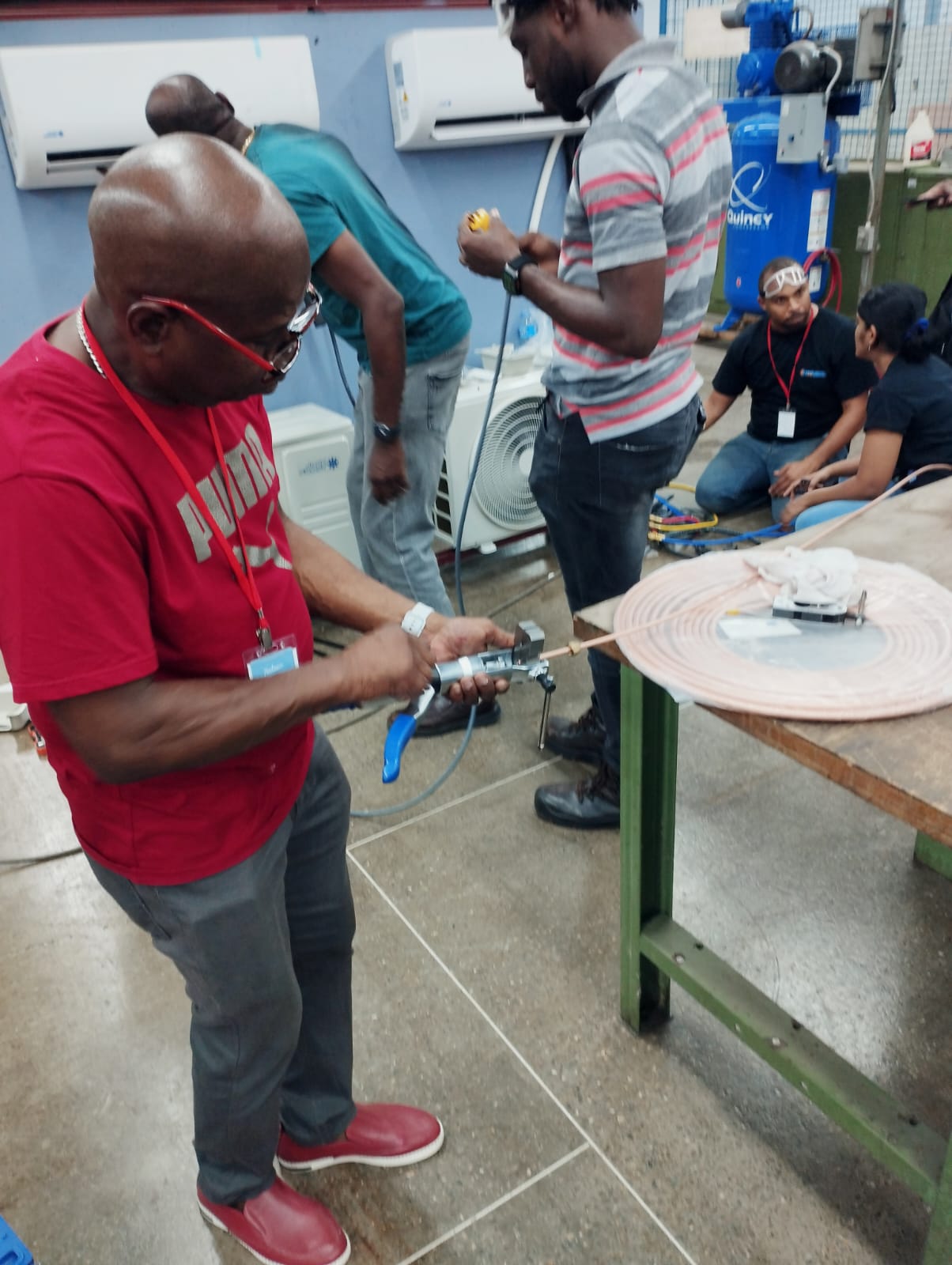
The Green Cooling Initiative III (GCI III) is a project of the International Climate Initiative (IKI) on behalf of the German Federal Ministry for the Environment, Nature Conservation, Nuclear Safety and Consumer Protection (BMUV) and aims to promote sustainable cooling technologies and thus protect the climate. To achieve this, GCI promotes the "Green Cooling" approach by strengthening different actors and their capacities and serves as a global platform for the exchange of experience and knowledge. One of the objectives is to improve technical capabilities in the safe use of natural refrigerants and facilitate the exchange of experience and expertise at the regional level. In this context this training is being organized in the region of Latin America and the Caribbean (LAC).
In the context of the GCI III project, GIZ Proklima conducted an advanced Training of Trainers (ToT) in natural refrigerants in Trinidad and Tobago in August 2023. The training was divided into theory and practical sessions. The theoretical part dealt with the different types of natural refrigerants with focus on HC, CO2 and NH3 and practice will have a focus on propane in commercial refrigeration. The training was led by Mr. Reiner Mayers (Professor of the training center BFS, Germany). The target group of the training were teachers of refrigeration and air conditioning technologies.




Friday, 11 August 2023
American Society of Heating, Refrigerating and Air-Conditioning Engineers (ASHRAE) Region XII Chapters Regional Conference August 9-12, 2023 at the Trinidad Hilton Port of Spain
The American Society of Heating, Refrigerating and Air-Conditioning Engineers (ASHRAE), founded in 1894, is a global society advancing human well-being through sustainable technology for the built environment. The Society and its members focus on building systems, energy efficiency, indoor air quality, refrigeration and sustainability within the industry.
ASHRAE’s Chapters Regional Conferences (CRCs) are
held each fall and spring and offer opportunities for chapters and members to
meet, interact, and socialize on a regional level. These conferences offer
workshops, technical sessions, technical tours, addresses by Society officers
and staff, and regional award presentations. CRCs provide an effective local
option for many members to actively participate in regional activities.
ASHRAE Region XII represents the Florida, Caribbean, and Central and South American membership of ASHRAE. The ASHRAE Region XII 2023 CRC took place at The Hilton Hotel, Port of Spain, Trinidad and Tobago during the period August 9-12, 2023.
The National Ozone Unit participated in this activity with the mounting of an informational booth as well as a talk on the Status of Montreal Protocol activities nationally.

Subscribe to:
Posts (Atom)